
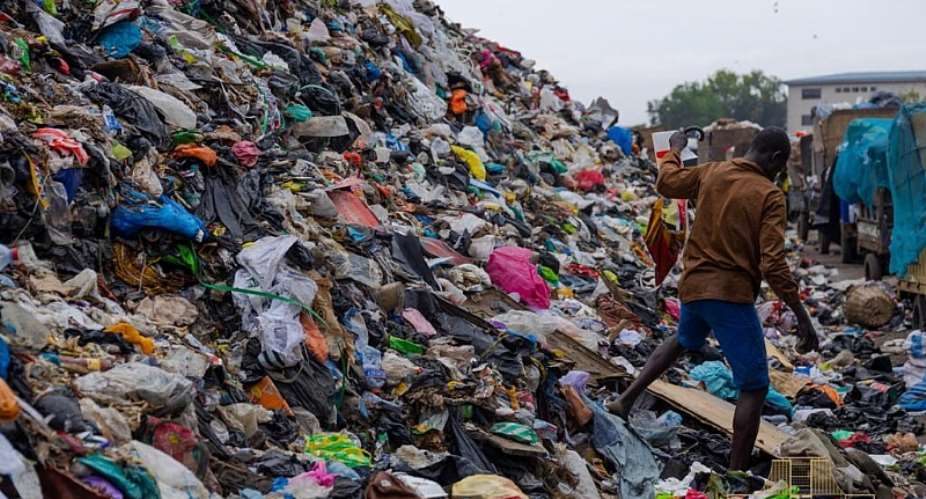
Ghana is losing more than GH¢6.2 billion every year because of poor waste management and sanitation, according to a study by the Institute of Statistical, Social and Economic Research (ISSER) of the University of Ghana.
The findings highlight the significant economic cost of inadequate sanitation, with the burden coming largely from healthcare expenses and productivity losses associated with sanitation-related diseases.
The study indicates that Ghana spends approximately GH¢5.58 billion annually on direct medical costs, while another GH¢650 million is lost through reduced productivity.
Together, these losses amount to more than GH¢6.2 billion every year.
Millions of work and school days lost
The economic impact also extends beyond direct financial costs.
ISSER estimates that diseases associated with poor sanitation result in about 31.9 million lost work and school days every year.
The illnesses identified include malaria, cholera and typhoid, among other preventable diseases linked to poor sanitation and inadequate waste management.
The study also estimates that sanitation-related illnesses contribute to 107,222 premature deaths annually.
MMDAs spend only GH¢180.2 million
Despite the scale of the economic losses, the study found that Ghana’s Metropolitan, Municipal and District Assemblies (MMDAs) collectively spend only about GH¢180.2 million on waste management and sanitation.
This creates a major imbalance between the money being spent to prevent sanitation problems and the much larger cost of dealing with their consequences.
ISSER argues that sanitation should therefore be viewed not simply as a social or environmental responsibility but as an economic investment capable of generating substantial returns.
Every GH¢1 invested can generate returns
The study’s cost-benefit analysis indicates that the economic gains from increased investment in sanitation could be significant.
Under the current spending situation, every GH¢1 invested in waste management is estimated to generate about GH¢180 in economic benefits.
Under a more ambitious investment scenario, where spending is increased to approximately GH¢1,028 per tonne of waste, the return could rise to about GH¢556 for every GH¢1 invested.
The researchers say the potential gains would come from lower healthcare costs, fewer deaths and improved productivity.
Urban growth putting pressure on sanitation systems
ISSER also points to rapid urbanisation, population growth and changing consumption patterns as factors contributing to Ghana’s growing waste-management challenge.
Many local authorities are struggling to keep pace with the increasing volume of solid and liquid waste being generated.
The consequences, according to the researchers, go beyond overflowing waste sites and unclean surroundings. Poor sanitation also affects public health, productivity and the wider economy.
ISSER calls for increased investment
The researchers are calling for increased government investment in sanitation infrastructure, drainage systems, waste collection and environmental health services.
They recommend that resources be directed towards areas where sanitation problems pose the greatest health risks, including densely populated communities, flood-prone neighbourhoods and underserved urban and peri-urban areas.
ISSER also recommends improved management of faecal sludge and action to eliminate open refuse dumps that contribute to the spread of disease.
The researchers argue that investing more in sanitation could reduce preventable illnesses, save lives and improve productivity while creating broader economic benefits for the country.
Sanitation as an economic priority
The findings put a financial value on a problem that is often treated mainly as an environmental or public-health concern.
With more than GH¢6.2 billion lost annually, ISSER’s research suggests that the cost of maintaining the current approach may be considerably higher than the cost of investing in better sanitation systems.
For Ghana, the challenge is therefore not only about keeping communities clean but also about reducing avoidable healthcare expenditure, protecting productivity and preventing deaths linked to inadequate sanitation.



Leave a Reply